

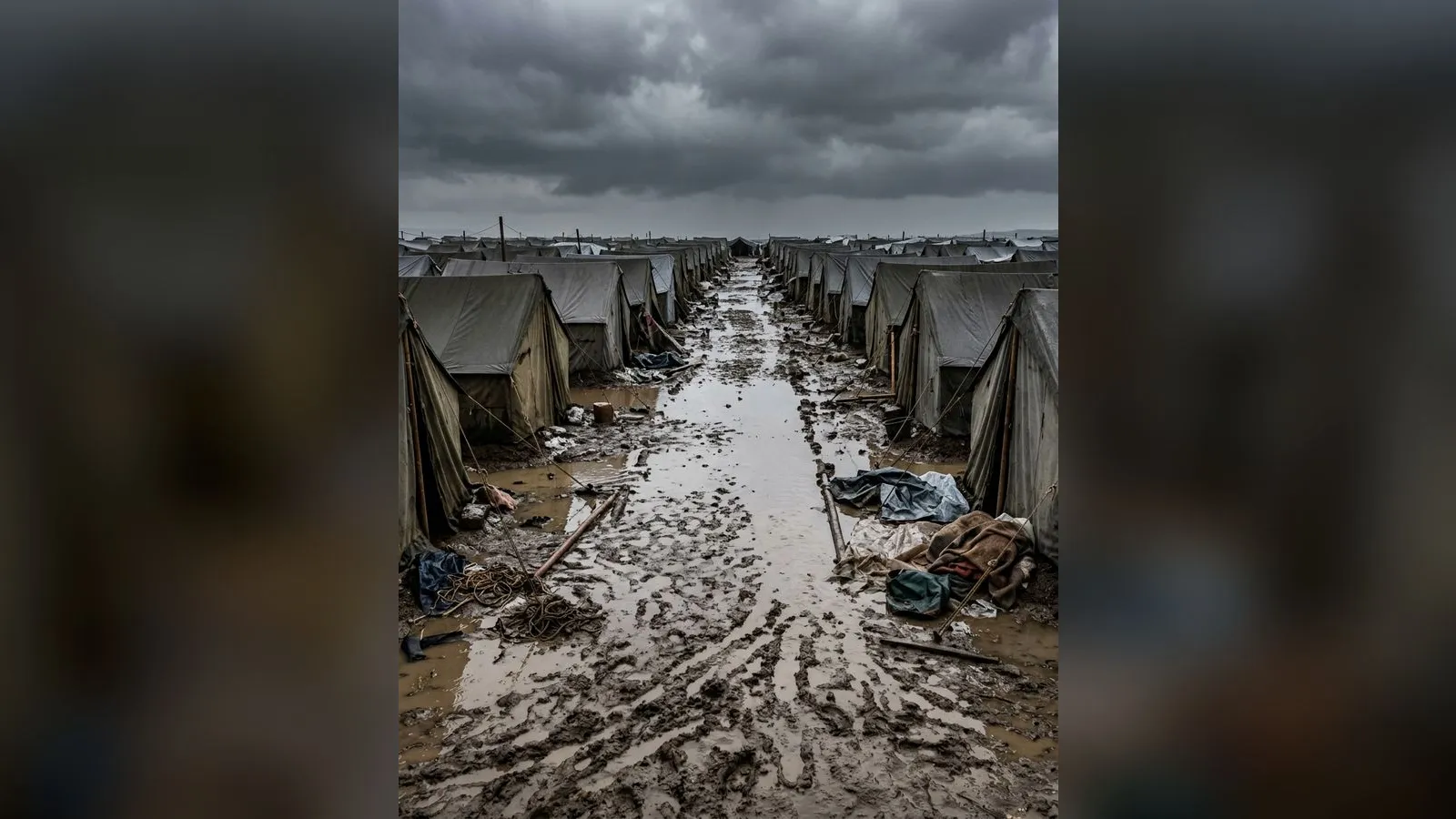
Families who lost their homes in Gaza’s war have now lost their tents too. A storm of heavy rain and strong winds that began late on Friday flooded about 70,000 tents across the Strip, according to the Hamas-run Government Media Office, leaving tens of thousands of displaced people without shelter as winter sets in. Officials say the territory’s damaged drains and a shortage of equipment are overwhelming emergency teams.
What the storm did
The media office estimated initial losses at about $3 million and said dozens of walls and cracked roofs came down. Medical sources told Anadolu that five Palestinians were hurt when two walls of buildings already damaged by Israeli strikes collapsed and a sheet of corrugated metal fell during the storm; the media office said some injuries were critical.
Hosni Muhanna, spokesman for Gaza Municipality, said families whose tents were wrecked “had nowhere to stay”. He described Gaza City as crowded beyond its limits: about one million residents and displaced people are squeezed into roughly 30 per cent of the city’s area, putting extra strain on infrastructure that Israel’s war devastated.
The weather itself was extreme for the area. The city received 60 millimetres of rain in 12 hours, about 15 per cent of its annual total, Muhanna said. Strong winds blew tents away or tore them open. Municipal crews took 250 calls about flooded streets, erosion and blocked drains and answered most of them with the little equipment they have. Muhanna warned that 270 camps and shelter sites in Gaza City are at risk of flooding, and that war damage has cut the drainage system’s capacity to 20 per cent, leaving low-lying districts especially exposed.
“Helpless” rescuers
Abdullah al-Majdalawi, public relations director of Gaza’s Civil Defense, said crews had taken hundreds of distress calls since the storm began, most about flooded tents and camps or about buildings and walls close to collapsing onto families’ shelters. Rescuers can deal with threats to life, he said, but cannot house the people affected, and he described them as helpless before the scale of the problem.
He blamed the lack of safer options on Israel’s blockade and its restrictions on mobile homes and reconstruction materials. Muhanna called for crossings to be fully opened so that winter supplies, relief materials and heavy machinery can reach Gaza.
The scale of need
| Source | Figure |
|---|---|
| UNRWA (surveys from June, statement on Thursday) | 1.98 million people, about 94% of the population, need shelter and essential supplies |
| UNRWA | 58% face critical or catastrophic shelter needs |
| UN OCHA (October) | 950,000 people live in displacement sites with moderate or high flood risk |
| UN OCHA (October) | More than 400,000 of them are in high-risk areas |
Shelter and reconstruction needs still far exceed the aid available, more than a year after the October 2025 ceasefire took effect, because Israel continues to restrict the materials needed for temporary housing and repairs, according to the Anadolu report.
Why it matters
The ceasefire has not ended the humanitarian emergency. As we reported when Gaza’s death toll passed 74,000 and the ceasefire stalled, the war’s effects continue to kill and injure people after the shooting slows. Winter makes that worse: families in tents with no drainage face cold, wet and disease, and the UN had already named the flood risk a month ago.
The facts above come from Palestinian officials, the UN and Anadolu, and several figures, including the loss estimate, are initial counts. What to watch is whether crossings open for winter supplies and heavy equipment, how many families are still without any roof in the coming days, and whether mobile homes and building materials are allowed in at scale.

Comments
Comments are reviewed by our editors before they appear. Please keep them civil and on topic. See our terms.
No comments yet. Be the first to share your view.