

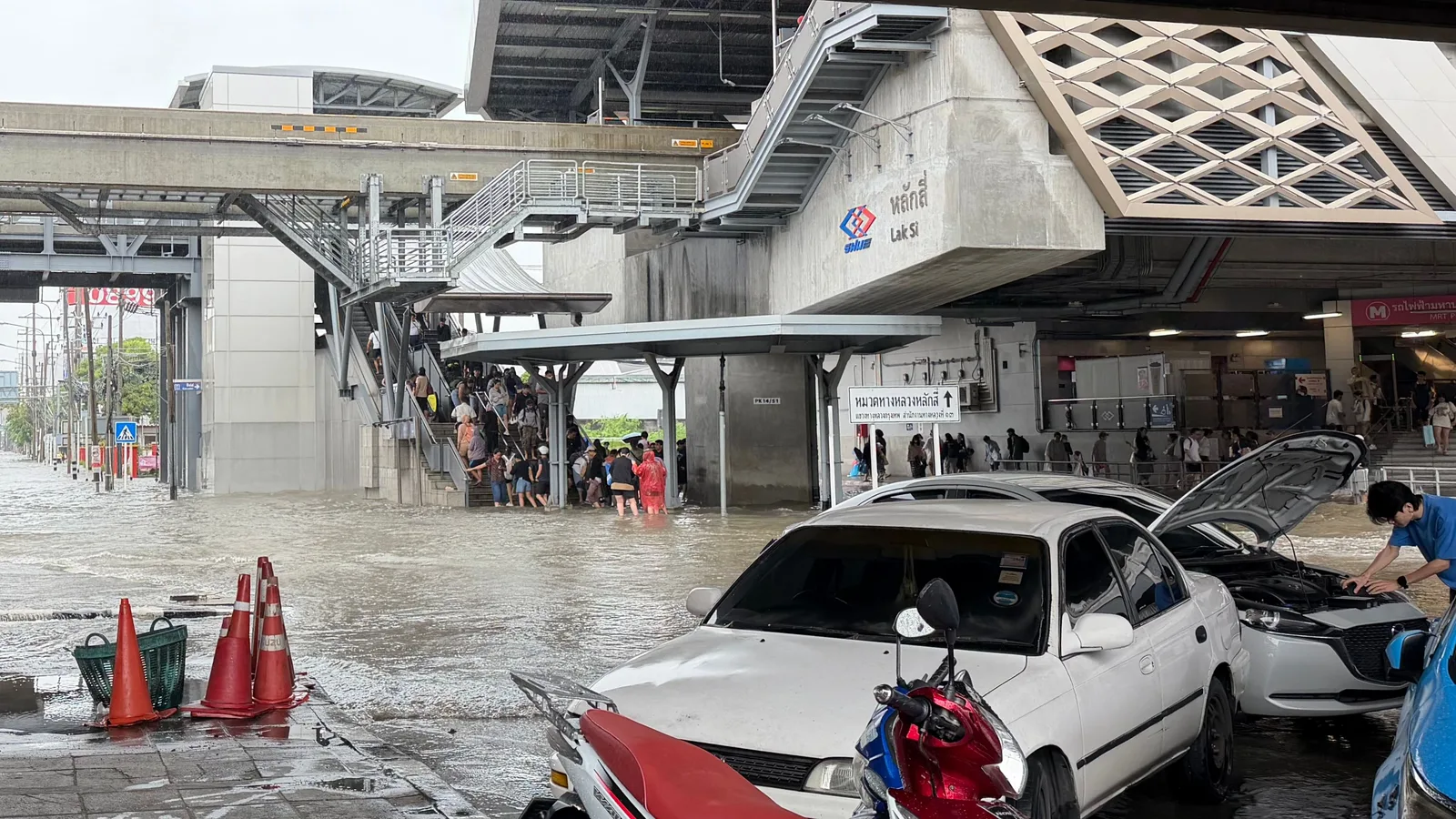
Floodwaters in Bangkok have begun to recede after days of torrential rain, but Thailand’s national carrier is still struggling with a baggage backlog at the capital’s main airport, with air force personnel called in to help clear it.
Bangkok received about 320mm (12.6 inches) of rain over two to three days last week, nearly as much as the city usually gets in the whole of September, Reuters reported. Officials expect standing water to clear within three days if no more rain falls.
Businesses hit across the country
The floods affected businesses well beyond the capital:
| Impact | Figure |
|---|---|
| Businesses affected | 1,267 |
| Provinces affected | 40 |
| Factories among them | 52 |
| Small and medium-sized enterprises | 1,162 |
| Estimated economic damage | More than $320 million |
Baggage chaos at Suvarnabhumi
The floods caused severe disruption to baggage handling at Suvarnabhumi Airport, Bangkok’s main international gateway and the home base of the national flag carrier, Thai Airways.
- 69 Thai Air Force personnel were deployed on Monday to support ground operations.
- 34 flights were delayed on Monday.
- Bags from 52 flights on 26 and 27 September were still being delivered to passengers.
- Eight flights were cancelled on Tuesday because of the flooding and problems with aircraft rotation.
Hundreds of bags were still lined up in the airport’s hallways on Tuesday, according to Reuters photographs. Bangkok’s main airports stayed open throughout the weekend’s flooding, but ground operations were badly affected.
Thai Airways cuts flights
In a later update, Reuters reported that Thai Airways planned to cut about 30 flights on Tuesday, roughly 30 per cent of its planned departures from Bangkok, and that the reduction would last for at least three days while the airline works through the disruption. Passengers booked on the flag carrier this week face the prospect of cancellations and rebooking.
Government to discuss long-term plans
Government spokesperson Ekkapob Pianpises said the cabinet would discuss long-term flood plans and recovery measures at its meeting on Tuesday.
A low-lying capital
Bangkok is built on low-lying land close to the sea, and heavy rain tests its drainage system. At the weekend, floodwater reached the Lak Si transport hub in the north of the city, where commuters had to wade through water to reach the station.
Lessons for Pakistan’s cities
The scenes in Bangkok echo those in Pakistan’s own cities during this year’s monsoon. On Monday, heavy rain lashed Islamabad and Rawalpindi, where WASA declared a rain emergency and two incoming flights were diverted because of bad weather. As in Bangkok, the challenge is keeping cities and airports running when the rain comes faster than the drains can cope.
Why it matters
Bangkok is one of Asia’s busiest travel hubs and a major centre for business and manufacturing. The floods have caused more than $320 million in damage and disrupted air travel for thousands of passengers, and the cabinet’s long-term flood plans will show how Thailand intends to protect its capital from the next heavy downpour.
This article draws on reporting by Reuters and Dawn.

Comments
Comments are reviewed by our editors before they appear. Please keep them civil and on topic. See our terms.
No comments yet. Be the first to share your view.