

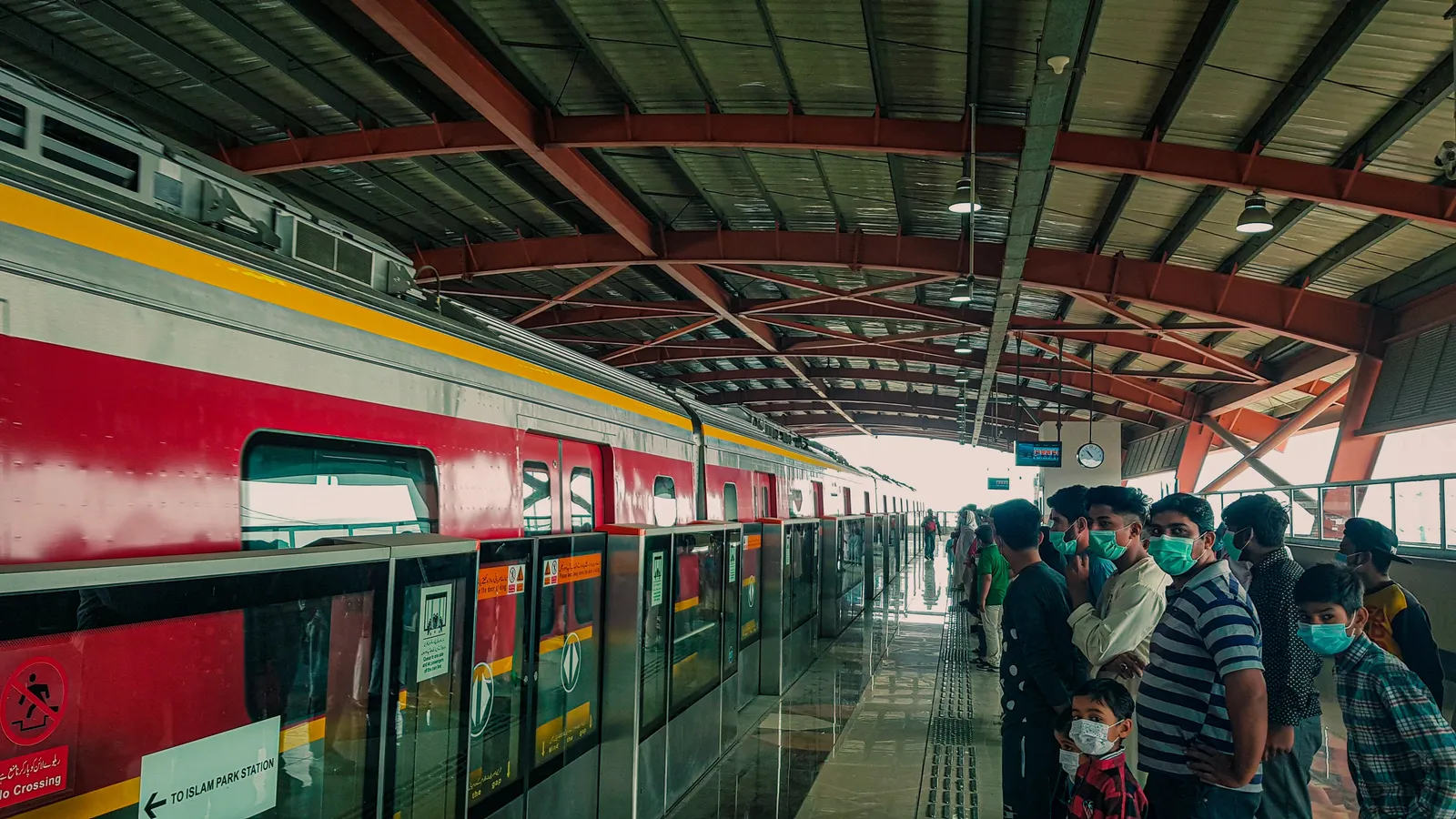
Two of Punjab’s best-known projects under the China-Pakistan Economic Corridor (CPEC) have published numbers for their first years of work: Lahore’s Orange Line metro and the Huaneng Sahiwal coal power plant, about 170 kilometres to its southwest. Both say they have moved from construction projects to daily services.
All of the figures below come from the projects’ operators. We have not independently checked them, and we flag what they leave out.
The numbers they give
| Orange Line Metro, Lahore | Huaneng Sahiwal plant | |
|---|---|---|
| Scale | Over 360 million passengers in six years | 1,320MW, built for $1.8bn, twin units |
| Daily or yearly use | About 260,000 passengers a day | 57 billion units (kWh) generated in nearly nine years of operation |
| Share claimed | n/a | Over 6 per cent of Pakistan’s power from 2.5 per cent of installed capacity |
| Tax | n/a | Over $820 million in federal and provincial taxes |
| Local staff | About 1,400, working with Chinese engineers | Over 700 Pakistanis |
The Orange Line
Tan, chief executive of the Norinco Metro-Daewoo Joint Venture, behind the line, says ridership has grown every year and that the metro has become a daily lifeline for the provincial capital.
A quick check fits that claim. Spread evenly across six years, 360 million rides would mean about 165,000 a day. At 260,000 a day now, the line is carrying more than half again as much as that average, which is what you would expect if numbers have been climbing. This is our own arithmetic from the operator’s totals, and it is only a rough guide.
The operator also lists what makes service harder:
- heavy monsoon rain and thick winter smog force speed restrictions;
- nationwide blackouts have at times stranded trains and forced emergency evacuations; and
- vandalism and structural damage, especially at stations 16, 17 and 18, have made it harder to restore normal service.
The Sahiwal plant
The 1,320MW, twin-unit plant is described as supplying around four million households. Its operators say it came back online within five hours after the nationwide blackout of 2020 and ran at 1,252MW during peak demand in Ramadan 2026.
The two projects are linked by more than geography: a metro that stops in a blackout depends on the kind of steady power a base-load plant provides, which is the point the operators make.
Another rough check: 57 billion units over nearly nine years averages out to roughly 720MW running all the time, about 55 per cent of what the plant could produce at full output. That is also our arithmetic, and the true operating period may differ. It is not unusual for a plant not to run flat out, but it shows the “6 per cent of the country’s power” figure should be read as a share of total output over the years, not a constant level.
Training, jobs and local spending
Since 2019 the plant’s Huaneng Training Academy has logged more than 6,000 attendances at its free vocational courses. Some local trainees have won places to study in China, and the plant says Waqas Rasool took first prize in a high-voltage cable inspection contest in Guangzhou in July 2026.
It also reports spending Rs95 million on nearby rural roads and bridges, planting more than 80,000 trees and working with local institutions and the Pakistan Army on free village medical camps. It supports the SOS Children’s Village in Lahore.
What the figures do not say
The operators’ numbers are the good news. Readers will want to know more:
- Price. The figures do not include the plant’s tariff or its capacity payments, which decide what its power costs consumers.
- Subsidy. It does not say how much the Orange Line costs the provincial government to run beyond fares.
- Emissions. A coal plant’s emissions matter in a province where winter smog is a public health problem. Planting trees is not a measure of them.
- Independence. Ridership and output are self-reported.
Why it matters
CPEC is entering what our columnist Bilal Javed has called its next phase, where the question is not whether projects exist but what ordinary people get from them. These two give measurable answers on jobs, training and electricity. Better answers still need public reporting of tariffs, subsidies and environmental data, the sort of information that would let a reader compare these projects with the Chashma-5 nuclear plant and with those that follow.


Comments
Comments are reviewed by our editors before they appear. Please keep them civil and on topic. See our terms.
No comments yet. Be the first to share your view.