
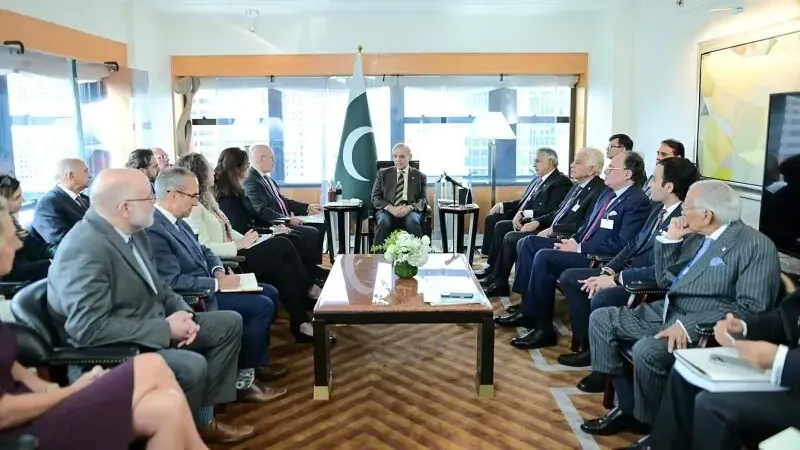
Prime Minister Shehbaz Sharif has told American business leaders that Pakistan’s economy has stabilised and is moving towards growth, and invited them, along with Pakistani-American entrepreneurs, to invest in the country.
The prime minister was speaking in New York on Friday at a meeting with delegations from the US-Pakistan Business Council and the US Business Council for International Understanding, on the sidelines of the 81st session of the UN General Assembly, where he addressed world leaders on regional security and the Indus Waters Treaty.
Reforms and a difficult backdrop
Shehbaz said Pakistan had carried out “massive structural reforms”, including digitising the economy, reforming the Federal Board of Revenue and expanding e-governance. “Our economy is now stable. We have moved towards growth,” he said.
He acknowledged that the crisis in the Gulf had hit Pakistan at a bad time, saying the country was “trying to stand on our feet” and doing its best to support peace efforts. The situation had been largely under control in June but had since deteriorated, he said, adding that regional peace was essential for business and investment.
Five areas for investors
The prime minister set out the sectors where he saw the greatest potential for cooperation:
- Agriculture, which he described as Pakistan’s biggest opportunity, through modern machinery such as combine harvesters to raise productivity and cut costs
- Mining, given the country’s large mineral reserves
- Information technology and AI-led initiatives, drawing on Pakistan’s young population, supported by vocational and skills training
- Energy security, saying Pakistan could offer safe storage for oil and gas reserves in light of the regional crisis
- Investment, imports and shipping
Privatisation on the table
Privatisation was another key pitch. The national carrier, Pakistan International Airlines (PIA), is in the process of being sold, and Shehbaz said he was confident its new Pakistani owners could revive it. He added that one bank had already been sold off and that electricity distribution companies in several provinces were next in line.
“The government’s business is to facilitate, act as a catalyst to support the private sector, not become the private sector,” he said.
Talks with the UN chief
The prime minister also met UN Secretary General António Guterres. According to the government, they discussed the Middle East and Afghanistan, including what Pakistan described as a sharp rise in terrorism from Afghan soil. Shehbaz reaffirmed Pakistan’s support for multilateralism and for Palestinian self-determination, and raised concerns about rising Islamophobia. The UN said Guterres expressed appreciation for Pakistan’s role as an elected member of the Security Council.
Meeting with the Aga Khan
In a separate meeting, Shehbaz met Prince Rahim al-Hussaini, Aga Khan V, praising the Ismaili community’s contribution to Pakistan’s development and the work of the Aga Khan Development Network in areas such as financial inclusion, tourism and cultural heritage. The Aga Khan expressed interest in expanding cooperation in health, education and climate resilience, and the prime minister invited him to visit Pakistan.
Foreign Minister Ishaq Dar, meanwhile, held talks with his counterparts from Bahrain and Singapore on strengthening bilateral ties.
Why it matters
Pakistan needs foreign investment to move from stabilisation to sustained growth, and the United States, together with the large Pakistani diaspora there, is an important potential source. The sectors the prime minister highlighted, particularly agriculture, mining and technology, are where investors have long seen promise but also obstacles, from regulation to security. Whether the pitch in New York translates into investment will depend on continued economic stability and on the regional situation that the prime minister himself described as a setback.
Reporting draws on statements from the Prime Minister’s Office and the Foreign Office, as reported by Dawn.

Comments
Comments are reviewed by our editors before they appear. Please keep them civil and on topic. See our terms.
No comments yet. Be the first to share your view.