

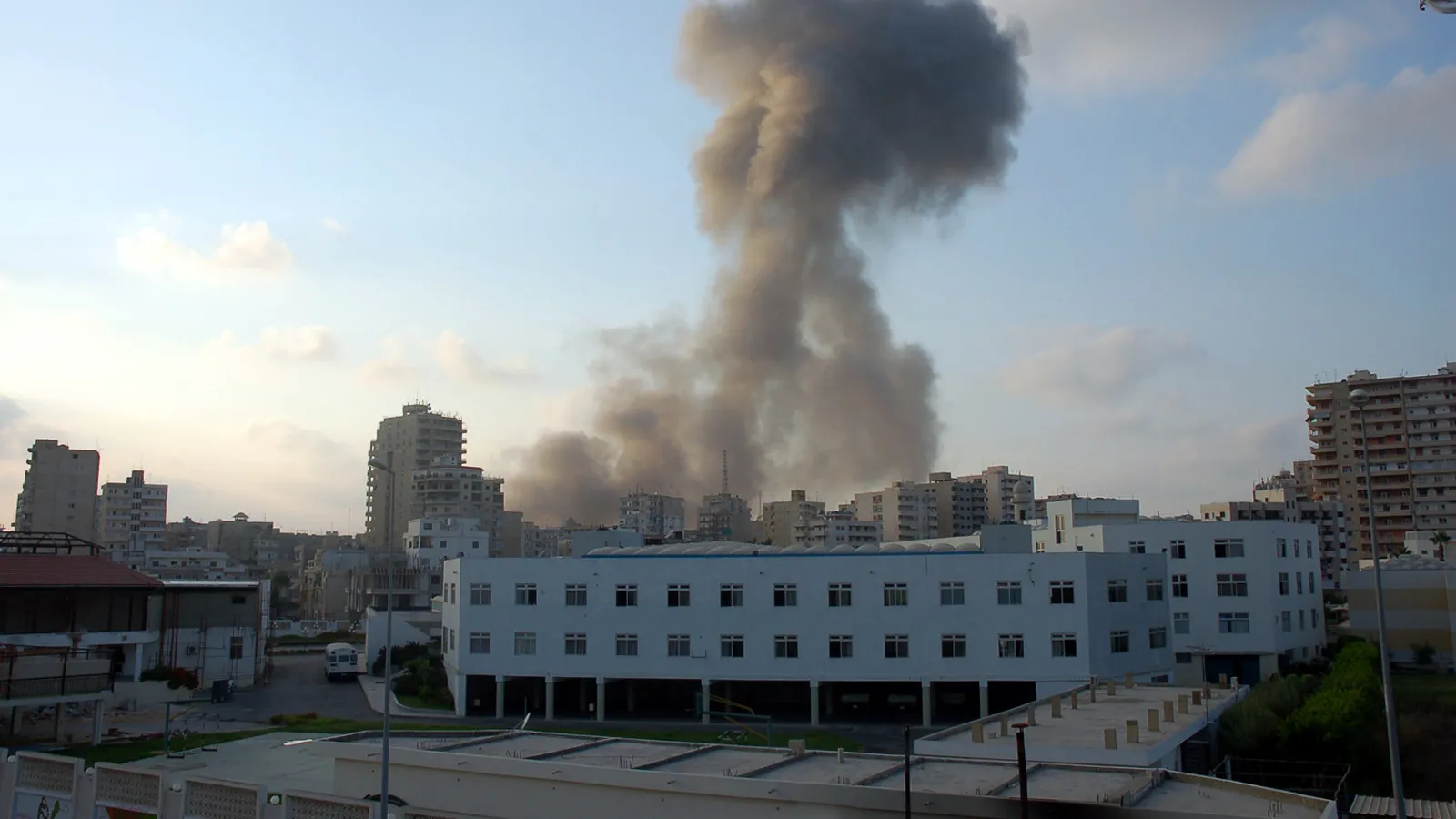
Israeli forces set off a massive explosion in the southern Lebanese town of Mansouri and demolished homes in the border town of Majdal Zoun, Lebanese media reported, even as Lebanon’s prime minister pressed Washington to make Israel honour a framework agreement that was supposed to bring about its withdrawal.
“A massive explosion rocked the town of Mansouri in the Tyre district a short while ago. The explosion was carried out by Israeli occupation forces,” Lebanon’s state-run National News Agency (NNA) reported. Large clouds of smoke rose over the town, much of which has already been destroyed.
Mansouri lies about 9km south of the coastal city of Tyre and about 10km north of the border with Israel. It had come under Israeli strikes and artillery shelling in recent weeks.
The Israeli military said it had completed an operation in the area in which it dismantled “more than 600 terrorist infrastructure sites” and “eight underground routes”.
Homes flattened in Majdal Zoun
On Tuesday, Israeli forces also demolished several houses in Majdal Zoun, another town in south Lebanon, the NNA reported, according to Al Jazeera. The demolitions came a day after Lebanon’s prime minister pressed Washington to make Israel keep its side of the ceasefire deal.
The human cost
The scale of the destruction is enormous. According to Lebanese authorities, Israeli attacks since March 2 have killed at least 4,386 people and injured 12,407, and more than one million people have been displaced, Anadolu Agency reported. Those attacks have continued despite the framework agreement.
A deal that has not been kept
A ceasefire took effect in June under a framework agreement brokered by the United States and signed on June 26. It provided for a gradual Israeli withdrawal from southern Lebanon and for Hezbollah to disarm. Its implementation has stalled.
Lebanese Prime Minister Nawaf Salam met US Secretary of State Marco Rubio in Washington on Monday and urged action on the “tripartite framework” between Lebanon, the United States and Israel. He said the principles agreed must be turned “into practical steps and tangible results on the ground”.
Salam called for Lebanon to regain “full sovereignty” and for a “complete Israeli withdrawal from Lebanese territory”. He asked for “a clear timetable for implementing the commitments” and a “credible mechanism” to monitor whether each side was keeping to them.
Rubio said the United States remained committed to supporting Lebanon, and described the framework as “the only path to a durable peace between Lebanon and Israel”.
What to watch
- Withdrawal timetable: Lebanon wants a clear timetable for Israeli forces to leave the south.
- Monitoring: Beirut is asking for a “credible mechanism” to check whether each side keeps its commitments.
- Regional war: The escalation in Lebanon comes as the wider Iran-US war keeps the region on edge, and as Israel’s far-right ministers push for annexation in the West Bank.
For the people of south Lebanon, the explosion in Mansouri was another reminder that a ceasefire on paper has not meant safety at home.
This article draws on reporting by Dawn, Al Jazeera and Anadolu Agency.
Comments
Comments are reviewed by our editors before they appear. Please keep them civil and on topic. See our terms.
No comments yet. Be the first to share your view.