

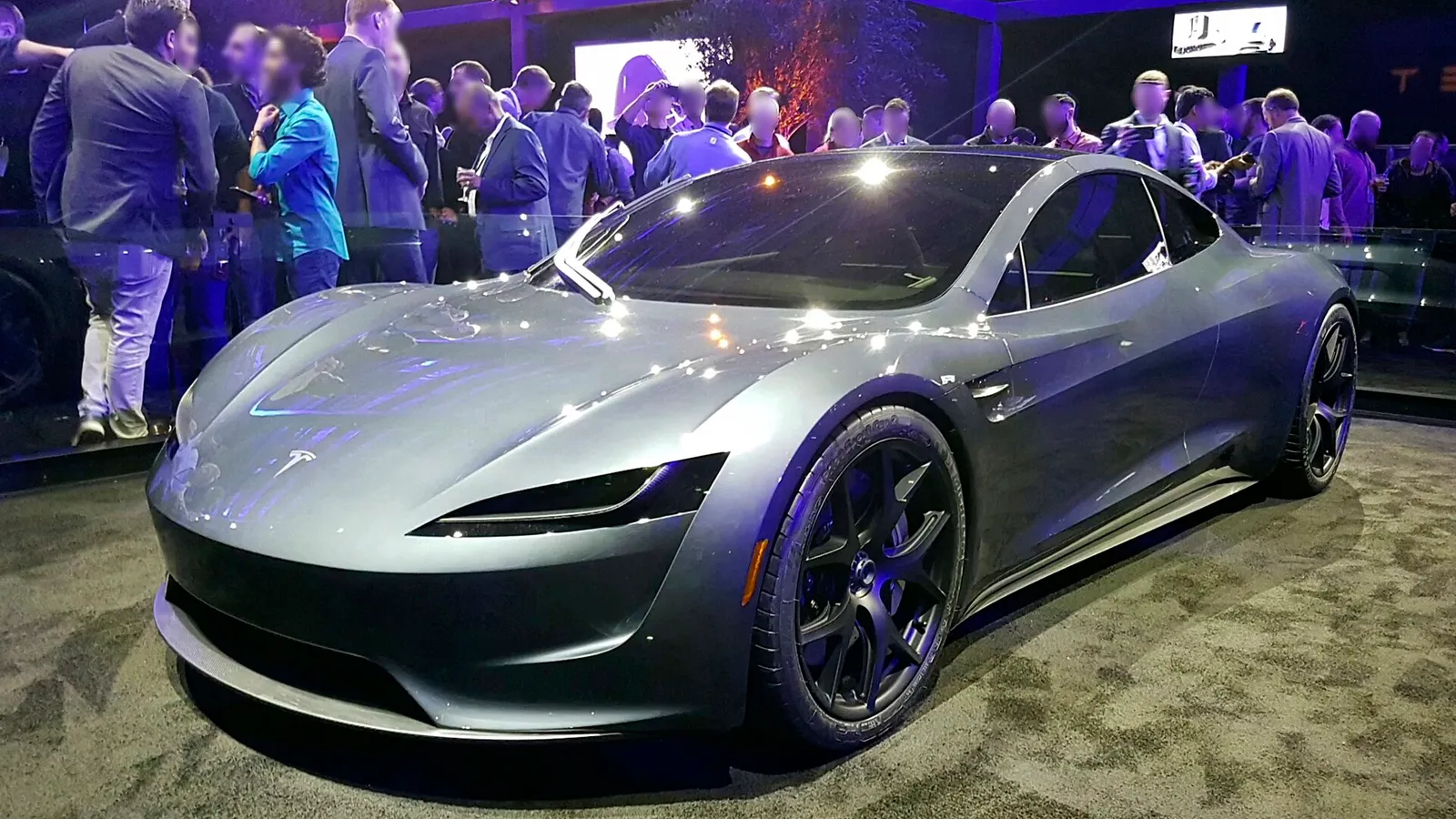
Tesla unveiled a redesigned Roadster powered by rocket-style thrusters on Thursday and said production would start in 2028, more than a decade after it first showed a next-generation version of its electric sports car.
The white two-seater, developed with Elon Musk’s rocket company SpaceX, drove upside down on a ramp using a suction system, turned in the air and landed using built-in thrusters, Geo News reported, citing Reuters. Later, it used the thrusters to jump over a truck and other vehicles, twisting in the air.
“This is the culmination of incredible work by Tesla and SpaceX engineers working closely together to make something that you haven’t seen in any movie,” Musk told a cheering crowd.
The numbers
- Acceleration: zero to 60mph (97km/h) in under one second, said Tesla vehicle engineering chief Lars Moravy
- Top speed: over 230mph (370km/h)
- Range: over 300 miles (480km) on a charge, less than half what Musk promised in 2017
- Deposits: $50,000 for the “Performance” version and $250,000 for the “Thrust” version with acceleration thrusters; a single-seat “Rocket” variant with a “full flight system” is invite-only
- Price: not announced, though Tesla quoted a base price of $200,000 nearly a decade ago
“Definitely much faster than that,” Musk said of the top speed. “I think you’ve got to crack halfway to the speed of sound.”
Spectacle or business?
“That was the most insane product demo I’ve ever seen,” Tesla investor Sawyer Merritt wrote on X.
Others were more sceptical. “It was an engineering flex with no commercial value beyond embarrassing traditional car makers,” said Gene Munster of Deepwater Asset Management. He said the event showed “why Elon can’t wait to bring (Tesla) and (SpaceX) together”, as some saw it as Musk drumming up interest in merging the two companies.
Musk has himself played down the car’s financial importance, calling it in 2023 a “small potato situation”. Morningstar analyst Seth Goldstein said the Roadster would be Tesla’s new “halo car”, a high-performance model to showcase its best technology.
Years of delays
When Tesla revealed the second-generation Roadster prototype in 2017, it said deliveries would begin in 2020. The original Roadster, sold from 2008 to 2012 on a Lotus Elise chassis, was Tesla’s first electric car.
A company changing course
The launch comes as Tesla shifts its focus to self-driving technology and robotics. This year it stopped selling the Model S and Model X to make room for production of its Optimus humanoid robots, and launched the Cybercab, a two-seater robotaxi with no steering wheel or pedals. Sales of its ageing car line-up have fallen over the past two years, though high fuel prices helped third-quarter deliveries, and the company reports results in the coming days.
Why it matters
The flying stunt grabbed headlines, but investors will judge Tesla on robotaxis, robots and quarterly profits. The Roadster shows what Musk’s companies can do together, and raises questions about where his empire is heading. Read our report on Musk’s call for Zelensky to step down.
This article draws on reporting by Geo News and Reuters.
Comments
Comments are reviewed by our editors before they appear. Please keep them civil and on topic. See our terms.
No comments yet. Be the first to share your view.