

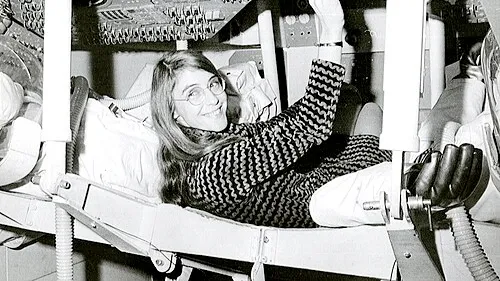
Margaret Hamilton, the American computer scientist who led the development of the software that guided NASA’s Apollo missions to the Moon, has died at the age of 90.
The Massachusetts Institute of Technology (MIT), where she worked from 1959 to the mid-1970s, called her a “computing pioneer” and said she died on September 30, Dawn reported.
“To say Margaret Hamilton was a pioneer, to say she was ahead of her time, would be a dramatic understatement,” said Olivier de Weck, interim head of MIT’s Department of Aeronautics and Astronautics. He said she developed advanced code at a time when software engineering was in its infancy, and led a team that built “one of the most complex systems humanity had ever achieved”.
The software that saved Apollo 11
Hamilton was credited with making critical onboard systems more robust and resistant to errors. About three minutes before the Eagle lander of Apollo 11 touched down on the Moon in 1969, her software stepped in to override a faulty script, allowing the landing to continue safely, according to NASA.
NASA chief Jared Isaacman called her “a pioneer whose work helped make Apollo and humanity’s first journeys to the moon possible”.
Jerry Wohletz, chief executive of the Draper Laboratory, which was spun out of MIT’s Instrumentation Lab, said her work on the onboard flight software for the Apollo Guidance Computer “helped ensure that Apollo astronauts landed safely on the lunar surface and safely returned home”.
From meteorology to the Moon
- Early life: born in Indiana in 1936, Hamilton studied mathematics before moving to Boston with her husband in 1959.
- MIT: she first worked in meteorology at MIT, then joined a lab in 1965 that was looking for people to write software to “send a man to the Moon”.
- First programmer: MIT said she was hired as the first programmer for the Apollo project at the university, and its first female programmer.
- Leadership: by 1968 she was assistant director in charge of Apollo’s Command and Service Module team, at a time when more than 400 people were working on Apollo’s software.
- Later career: she published more than 130 papers and founded two software companies, Higher Order Software and Hamilton Technologies.
‘No second chance’
In 2009, Hamilton told MIT News: “There was no second chance. We knew that. We took our work seriously, many of us beginning this journey while still in our 20s.”
“Because software was a mystery, a black box, upper management gave us total freedom and trust,” she said. “Looking back, we were the luckiest people in the world; there was no choice but to be pioneers.”
Honours
President Barack Obama awarded Hamilton the Presidential Medal of Freedom, the highest US civilian honour, in 2016 for her achievements.
Why it matters
Hamilton’s team wrote the code for the Apollo Guidance Computer at a time when, as MIT put it, software engineering was in its infancy. The safeguards she built into that code were tested in the final minutes of the first Moon landing, and helped bring the Apollo astronauts home safely.
This article draws on reporting by Dawn and AFP.




Comments
Comments are reviewed by our editors before they appear. Please keep them civil and on topic. See our terms.
No comments yet. Be the first to share your view.