

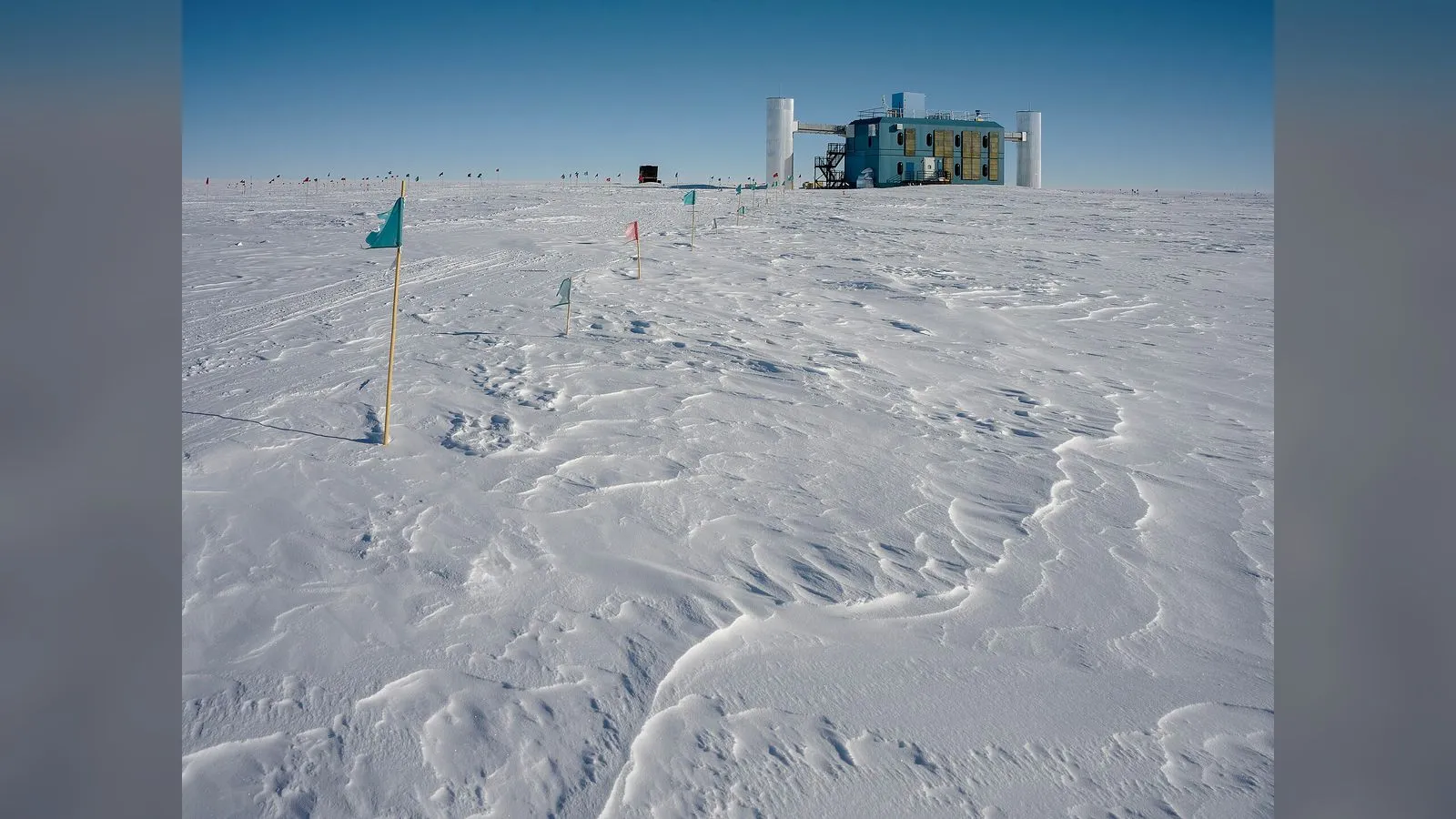
Belgian physicist Francis Halzen has won the 2026 Nobel Prize in Physics for his work on catching “ghostly” subatomic particles from deep space with a giant detector buried in the ice at the South Pole.
“This year’s prize is about ghostly messengers from space,” said Ellen Moons, secretary general of the Royal Swedish Academy of Sciences, Dawn reported, citing AFP.
The citation
Halzen was honoured “for decisive contributions to the IceCube Neutrino Observatory and the discovery of high-energy neutrinos of astrophysical origin”, the jury said. The academy said his “vision and scientific leadership” were fundamental to the observatory.
A cubic kilometre of ice
The academy described IceCube as “a cubic kilometre of ice that is equipped with light sensors”. With it, researchers capture neutrinos, rare subatomic particles, “from extremely energy-rich processes in the distant universe”.
“This Nobel Prize is about a giant ice cube positioned at the South Pole of our globe. The ice cube enables the detection of neutrinos,” said Professor Eva Olsson, a member of the Nobel Committee for Physics.
How the observatory works:
- Location: built by the University of Wisconsin-Madison at the Amundsen-Scott South Pole Station in Antarctica
- Sensors: thousands of light sensors spread through a cubic kilometre of ice, hung on strings at depths of about 1,450 to 2,450 metres in holes melted with a hot-water drill
- Target: neutrinos with extremely high energies, which point back to violent events far across the universe
- Timeline: completed in December 2010, with an upgrade announced as deployed in February 2026
IceCube is a recognised CERN experiment and the successor to an earlier South Pole detector, AMANDA. Each sensor carries a light detector and a small computer that sends data to a counting house on the surface.
“A great surprise”
Halzen, 82, was born in Tienen, Belgium, and is a professor at the University of Wisconsin-Madison, where he leads the IceCube project as its principal investigator.
“It was a great surprise, and I obviously didn’t expect it,” he said by telephone shortly after the announcement. “But it’s a great pleasure to hear about this prize.”
The Nobel week so far
The physics prize is the second of the season:
- Monday, medicine: Karl Deisseroth, Peter Hegemann and Georg Nagel, for optogenetics
- Wednesday: chemistry
- Thursday: literature, with some pundits expecting a woman writer, possibly from Latin America
- Friday: peace, the most closely watched award. US President Donald Trump lobbied hard for it last year
Last year’s physics prize went to John Clarke, Michel Devoret and John Martinis for putting quantum mechanics to work in technology.
The prize includes a diploma, a gold medal and 12 million Swedish kronor, about $1.2 million. The awards are presented on December 10, the anniversary of Alfred Nobel’s death in 1896.
Why it matters
IceCube opened a new window on the universe: instead of only looking at light, scientists can now study particles that travel straight to Earth from the most violent places in the cosmos. Halzen’s prize honours decades of work in one of the harshest places on the planet. Read our report on this year’s medicine prize.
This article draws on reporting by Dawn and AFP, with background on IceCube from Wikipedia.

Comments
Comments are reviewed by our editors before they appear. Please keep them civil and on topic. See our terms.
No comments yet. Be the first to share your view.