

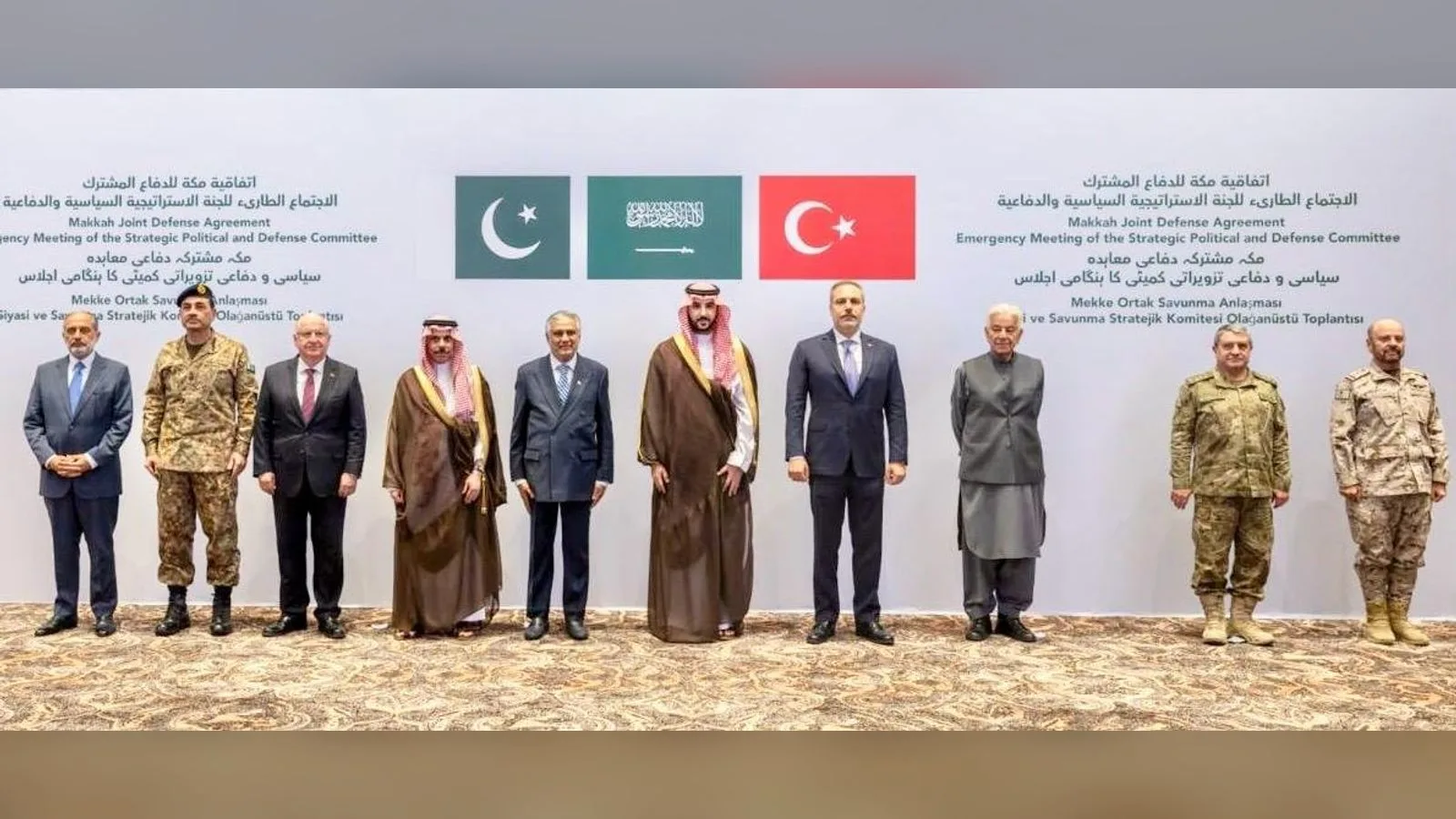
The text of the Makkah Joint Defence Agreement between Pakistan, Saudi Arabia and Turkey commits the three countries to defend one another, declaring that an armed attack from outside on any one of them will be treated as an attack on all.
The Turkish government submitted the agreement to its parliament for ratification on Tuesday, and Middle East Eye published what it said was the full text of the 16-article pact, signed in Makkah on August 7.
Parliament Speaker Numan Kurtulmus will send the agreement to the parliament’s foreign affairs commission after returning from Kyrgyzstan, two sources told Reuters.
“An attack against all”
The key clauses, according to the unofficial translation published by Middle East Eye:
- Article 1: if the territorial integrity, sovereignty or internationally recognised borders of any party are threatened, “the Parties shall use all necessary means to eliminate such threat(s) or danger(s)”
- Article 2: “An externally originating armed attack against any of the Parties shall be considered an attack against all the Parties.” The others “shall immediately assist the attacked Party”, within their available resources, “including military means and capabilities”, in line with the right of self-defence under Article 51 of the UN Charter
- No named enemy: the text does not identify any country or region as a threat
The commitment is similar to Article 5 of the North Atlantic Treaty, the founding treaty of Nato.
What else the pact covers
- Defence industry: technology sharing, joint research, joint production and training of personnel
- Supplies: logistical support in peacetime, wartime and emergencies, including weapons, ammunition, fuel and spare parts
- Intelligence: sharing through agreed secure channels
- Terrorism: stronger cooperation, including at the operational level, against terrorism in all its forms
- Training: personnel exchanges, joint exercises and deployments to improve how the three armed forces work together
A Pakistani at the helm
The pact sets up a Strategic Political and Defence Committee of the three countries’ foreign ministers, defence ministers and chiefs of general staff, meeting twice a year. Its secretariat will be headquartered in Saudi Arabia, led by a secretary-general serving a rotating three-year term.
“The first Secretary-General shall be a citizen of the Islamic Republic of Pakistan,” the text says.
The committee can approve the rules for other countries to join, by consensus of the three founding members. The agreement has no expiry date; a country may withdraw only after 10 years, with at least three months’ written notice.
The committee held an emergency meeting in Riyadh on October 5, attended for Pakistan by Deputy Prime Minister Ishaq Dar, Defence Minister Khawaja Asif and Field Marshal Asim Munir.
Pakistan’s position
The pact followed the Strategic Mutual Defence Agreement signed by Pakistan and Saudi Arabia in September 2025. ISPR Director General Lt Gen Ahmed Sharif Chaudhry has described the Makkah alliance as purely defensive, but said any direct or indirect attack on Pakistan, Saudi Arabia or Turkiye “will trigger a collective response”.
He said Pakistan considered Saudi Arabia’s sovereignty and the security of the Haramain Sharifain “non-negotiable”, while urging Muslim countries to stop attacking each other and seek a negotiated outcome. He said Egypt’s and Syria’s reported interest in joining would be considered at the appropriate levels.
Why it matters
With the Houthis striking Saudi cities, the pact’s commitments are no longer theoretical. The published text shows how far Pakistan has bound itself to the defence of the Haramain and its allies, and the central role Islamabad will play in running the alliance. Read our reports on the pact’s emergency meeting in Riyadh and on the UK’s decision to send jets to defend Saudi Arabia.
This article draws on reporting by Middle East Eye, Reuters and The Express Tribune.
Comments
Comments are reviewed by our editors before they appear. Please keep them civil and on topic. See our terms.
No comments yet. Be the first to share your view.