

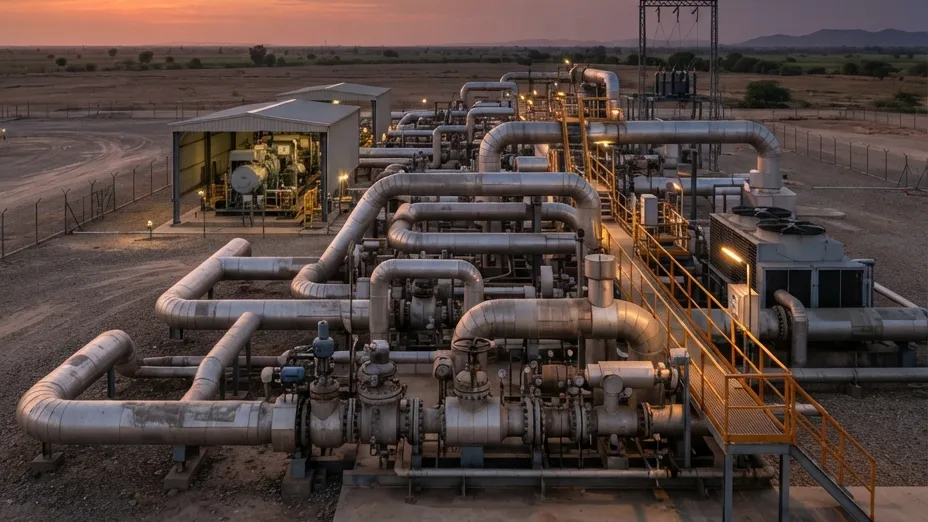
The Petroleum Division has drawn up a plan to divide the two Sui gas companies into six to eight smaller businesses, intended to turn today’s monopolies into a competitive market. A summary of the plan has been sent to Prime Minister Shehbaz Sharif for approval in principle, Petroleum Division sources told journalists, as Dawn reported.
What the plan does
The core idea, the summary says, is “the separation of molecules from pipes”. Pipelines and distribution networks would be run apart from the businesses that buy and sell gas. At present Sui Northern Gas Pipelines (SNGPL) and Sui Southern Gas Company (SSGCL) do both, which means each runs the network that all users are meant to be able to use while also selling gas in competition with them.
- At least four sales companies are proposed: two “competitive gas supply” (CGS) firms serving commercial and industrial users, and two “regulated gas supply” (RGS) firms serving households.
- The Sui companies would free 20 percent of their supply and customer portfolios to the CGS companies in the first year and 10 percent in each of the next two years, so that private firms can compete.
- Gas circular debt of over Rs3 trillion would be moved into a special purpose vehicle, copying the Power Holding Company model used for electricity, and repaid through a surcharge added to consumer tariffs.
- The prime minister must authorise the hiring of transaction advisers, who would take five to six months to work through the remaining legal, constitutional, regulatory and financial requirements. A top official said the plan would move to implementation by the fourth quarter of 2027.
The World Bank, KPMG and Wood Mackenzie helped prepare it, and the sources said the IMF is on board, since its clearance is needed under the current programme. An earlier attempt in 2016-17 by the PML-N government to create four provincial distribution companies and a transmission company did not succeed.
The numbers that matter to households
The projections, based on the companies’ FY2025 accounts, show a clear split between businesses that would make money and the one that would not.
| SNGPL | SSGCL | |
|---|---|---|
| Transportation, after-tax profit | Rs24bn | Rs27.4bn |
| Competitive supply (CGS), after-tax profit | Rs36bn | Rs19.6bn |
| Household supply (RGS), after-tax result | loss of Rs158bn | loss of Rs59bn |
| Average household price per MCF | Rs1,268 | Rs732 |
| Break-even household price per MCF | Rs2,152 | Rs1,337 |
| Rise needed to break even | 69.8% | 82.7% |
For SNGPL’s household segment, gas costs Rs322bn against sales revenue of Rs224bn. If prices are not raised, the state would need to pay about Rs150bn in subsidy. Commercial and industrial users, by contrast, pay an average Rs2,893 per MCF against a break-even Rs2,737, which leaves room for a 5.4 percent cut at SNGPL; SSGCL’s room is 7.4 percent.
The modelling concludes that household supply stays loss-making in every scenario. The government’s answer is to raise prices in steps, reduce household billing slabs from 12 to a single one, and pay direct subsidies to protected consumers through the social safety net.
Investment
The plan seeks Rs736bn in capital spending at SNGPL over six years from FY2027 to FY2032, peaking at Rs165bn in 2030, and Rs390bn at SSGCL. To pay for it, it proposes multi-year tariffs based on a regulatory asset base, the method used for K-Electric.
Why it matters
Gas is the fuel behind household cooking and winter heating for millions, and supply is already tight. We reported earlier this month that SSGC will supply homes in Sindh and Balochistan only at breakfast, lunch and dinner hours this winter: SSGC’s winter gas schedule. The gas plan is the longer-term answer, but the plan’s own projections point to higher bills for households as its first visible effect. Prices that must rise 70 to 83 percent to cover cost cannot rise at once without hardship, which is why the design leans on a slab simplification and targeted help.
For industry, the plan offers the prospect of choosing a supplier and slightly lower prices.
What we do not know
- Whether the prime minister will approve the plan quickly, and whether it goes to the cabinet, the Council of Common Interests or parliament.
- How the provinces will react, given that the 2016-17 attempt, which involved provincial companies, did not succeed.
- How fast tariffs would rise, and who would qualify as protected.
Comments
Comments are reviewed by our editors before they appear. Please keep them civil and on topic. See our terms.
No comments yet. Be the first to share your view.