
Artificial intelligence is quickly taking a bigger role in warfare at the expense of human judgement, the head of the UN’s independent disarmament research institute has warned, while Pakistan cautioned that advances in AI and the life and chemical sciences are creating new and unpredictable risks, Dawn reported.
“Are we going to let machines target and kill?”
At a briefing at UN headquarters, Robin Geiss, director of the UN Institute for Disarmament Research (UNIDIR), put a stark question to the international community: “Are we going to let machines target and kill human beings?”
He warned that military AI was increasingly “on track to crowding out human decision-making”, including in the nuclear domain.
AI is already used for intelligence analysis, identifying targets, operating drones and cyberattacks. According to Geiss, its growing role is speeding up operations on the battlefield, shortening the time between spotting a target and striking it, and allowing forces to hit unprecedented numbers of targets each day.
Why it is risky
Geiss said many AI systems are opaque, which raises the risk of errors, miscalculation and unintended escalation. As the tools become easier to use, he said, armed groups that are not states could also gain the ability to run increasingly sophisticated military operations.
He accepted that rivalry between major powers remained a serious obstacle to regulating military AI. But he said concern about the risks was increasingly shared across political divides.
In September, the United States proposed an AI “notification mechanism” with China, under which the world’s two largest military spenders would alert each other to AI incidents that threaten national security.
A new UN forum
Geiss pointed to growing support for UN Secretary-General António Guterres’s calls for stronger regulation of military AI and a legally binding treaty on lethal autonomous weapon systems. Guterres has warned that technology must not cross a “moral red line”.
UNIDIR’s Centre of Excellence on AI, Peace and Security is launching a new forum on AI, international peace and security and the military domain. Geiss described it as the first and only forum of its kind in the UN system. It will focus on:
- voluntary guidelines for responsible industry practice in military AI
- a common security vocabulary to clarify ideas such as autonomy and safety
- the possible misuse of AI by non-state armed groups in planning, carrying out and supplying operations
Pakistan: “Science is moving faster than governance”
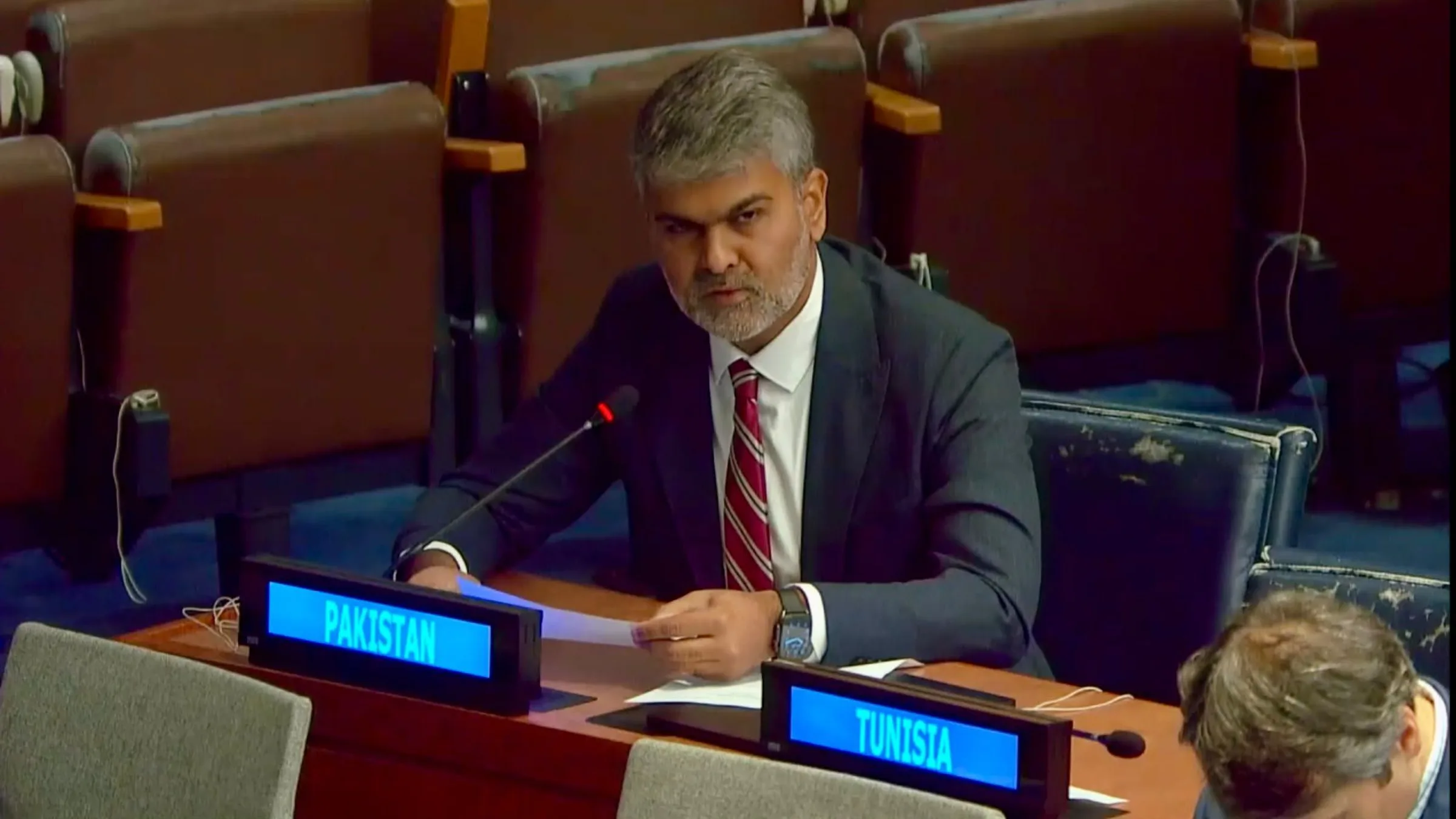
Separately, Pakistan raised the convergence of AI, synthetic biology and advances in the life and chemical sciences during a debate on other weapons of mass destruction at the UN General Assembly’s First Committee, which deals with disarmament.
“Science is moving faster than governance,” Counsellor Syed Atif Raza told the committee, warning that emerging technologies were creating new kinds of risk.
Pakistan’s mission to the UN said rapid advances in the life and chemical sciences, increasingly converging with AI and synthetic biology, were among the issues it raised during the debate on October 20.
The role of private technology in war has also been in the spotlight this week, after reports that Elon Musk ordered a slowdown of the Starshield service used by Kyiv.



Comments
Comments are reviewed by our editors before they appear. Please keep them civil and on topic. See our terms.
No comments yet. Be the first to share your view.