

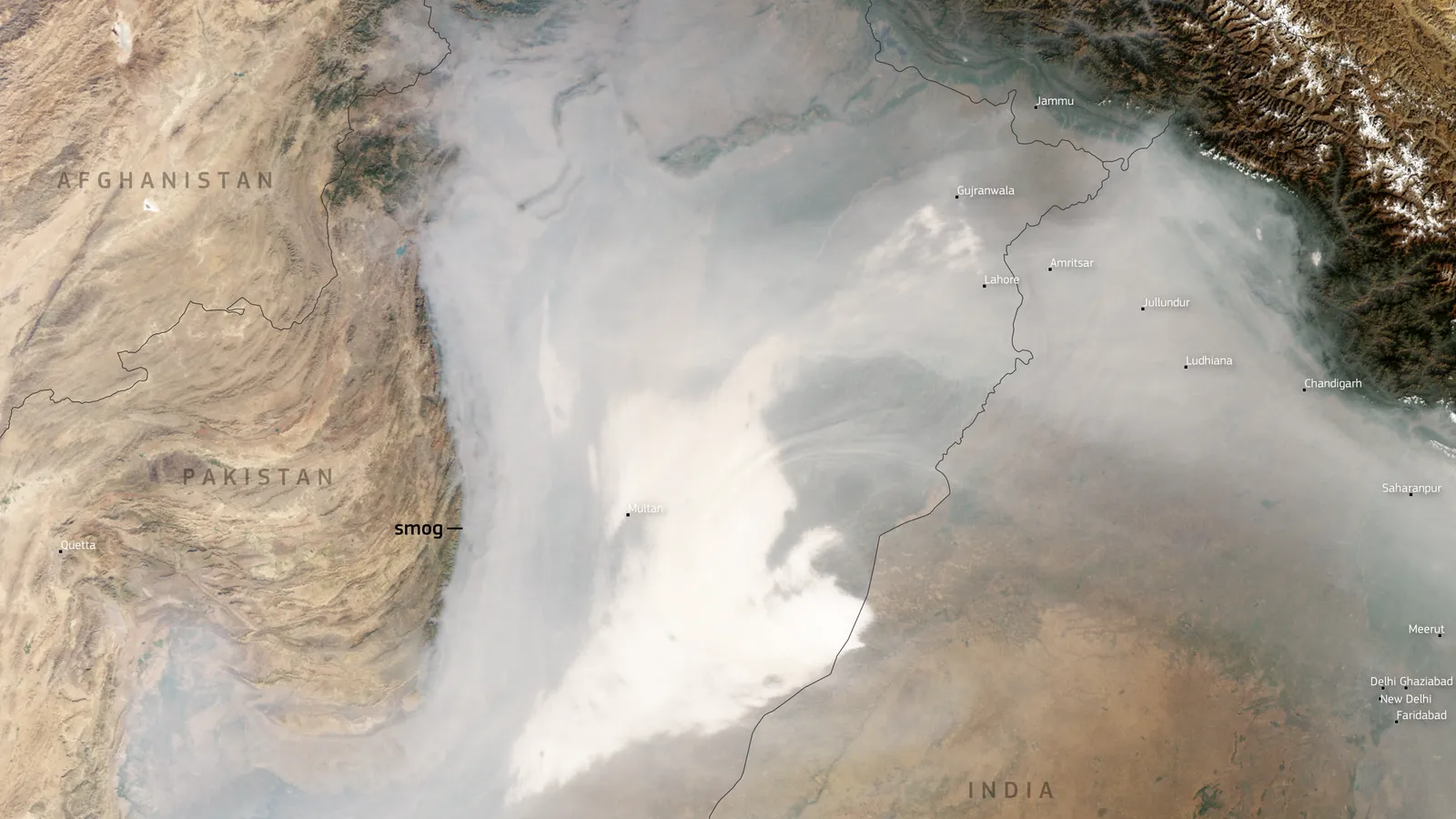
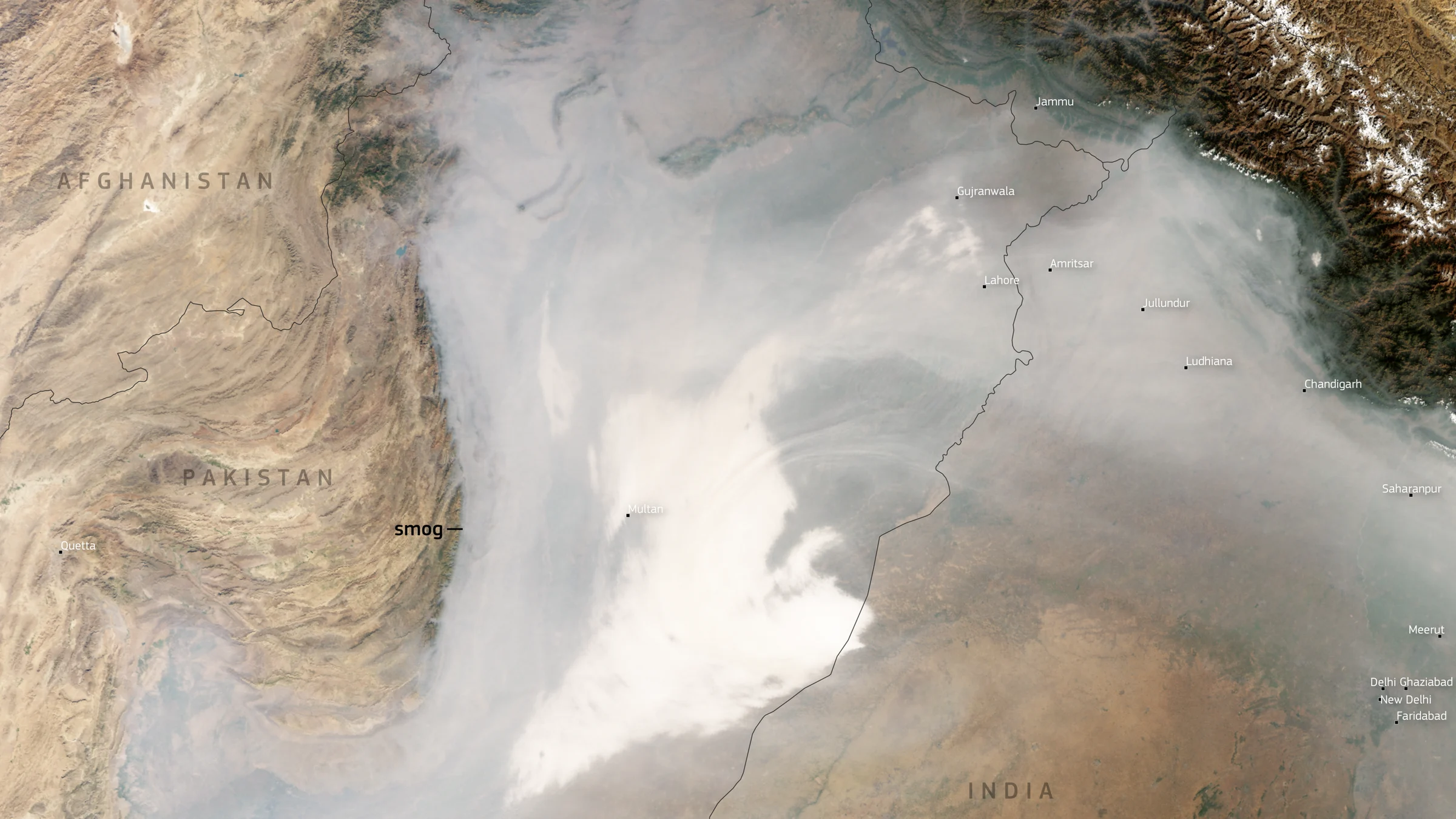
A satellite-based analysis by the Pakistan Air Quality Initiative (PAQI) found that fire activity around Lahore has risen sharply this autumn, with more hotspots on the Pakistani side of the border than the Indian side, The Express Tribune reported.
What the data shows
Between October 27 and November 2, 2026, PAQI counted 3,712 fire hotspots within a 300-kilometre radius of Lahore: 2,753 in Pakistan and 957 in India. The analysis uses data from NASA’s Fire Information for Resource Management System (FIRMS).
- The Pakistani figure was 15 per cent higher than the 2,390 recorded in the same week last year.
- It was 51 per cent above the eight-year average of 1,824 for the same dates between 2018 and 2025.
- The Indian figure was far below its eight-year average of 10,448 for the period.
For both countries together, the same week produced 19,674 hotspots in 2018, 10,563 in 2019, 21,157 in 2020, 15,860 in 2021, 16,118 in 2022, 6,743 in 2023, 4,464 in 2024 and 3,667 in 2025. This year’s combined total is 3,712, close to last year’s level and far below the earlier years.
Pollution rose at the same time
PAQI found that a rise in hotspots in the second half of October coincided with higher levels of fine particulate matter (PM2.5). Lahore’s daily average PM2.5 climbed from around 220 to 285 micrograms per cubic metre near November 1 and 2. The analysis does not establish that crop-residue burning was the only cause of the increase.
To see where the air reaching Lahore came from, researchers used the US National Oceanic and Atmospheric Administration’s HYSPLIT model to track air movement at an altitude of 500 metres over the preceding 72 hours. The model showed air masses arriving from both Afghanistan and India. Punjab Senior Minister Marriyum Aurangzeb has said that winds from the Indian cities of Amritsar and Attari add to Lahore’s pollution. The Tribune noted that air-trajectory modelling shows possible movement of air, and does not on its own prove the source of pollutants.
A second dataset
Separate data published by HamariHawa on November 3 showed heavy fire activity across Pakistani Punjab. In the preceding seven days, 10,494 hotspots were recorded within 250 km of Faisalabad, 10,115 around Lahore, 9,537 around Sargodha and 8,836 around Gujranwala. Indian Punjab recorded 8,892 around Amritsar, 6,853 around Ludhiana and 3,210 around Chandigarh. These figures use different radii and dates from the PAQI analysis, so they should not be added together or compared one-to-one with it.
Why hotspots are not the same as crop burning
Experts quoted by the Tribune urged caution in reading the numbers:
- A hotspot shows heat or fire, but not what caused it, and it does not measure how much smoke it released.
- Each detection represents an area of about 375 metres.
- Cloud cover can hide fires from the satellite.
- Finding the sources of Lahore’s smog needs satellite observations, ground-level air quality monitors and weather data used together.
Background
Lahore has been near the top of global pollution rankings for weeks. We reported on Lahore’s AQI passing 530 and Gujranwala reaching 606 on November 2, and earlier on the city’s anti-smog squads ahead of stubble burning. The Overseas Investors Chamber of Commerce and Industry cited a cost of about 6.5 per cent of GDP from air pollution in figures reported today; see our report on that estimate.
Why it matters
Residents in Lahore and across central Punjab are living with unhealthy air during the peak weeks of the season, and the data suggests that fires on both sides of the border are one of several contributing factors. The data also shows that the problem is not simply a matter of one country’s fields: the combined total is far lower than in 2018 to 2022, yet Pakistan’s own count is above its average. That points to a need for local enforcement against crop burning, brick kilns and industrial smoke as well as talks with neighbouring governments. What to watch is whether PM2.5 levels keep rising in the coming days, whether Punjab’s anti-smog measures reduce the fires, and whether a fuller source study appears.

Comments
Comments are reviewed by our editors before they appear. Please keep them civil and on topic. See our terms.
No comments yet. Be the first to share your view.