

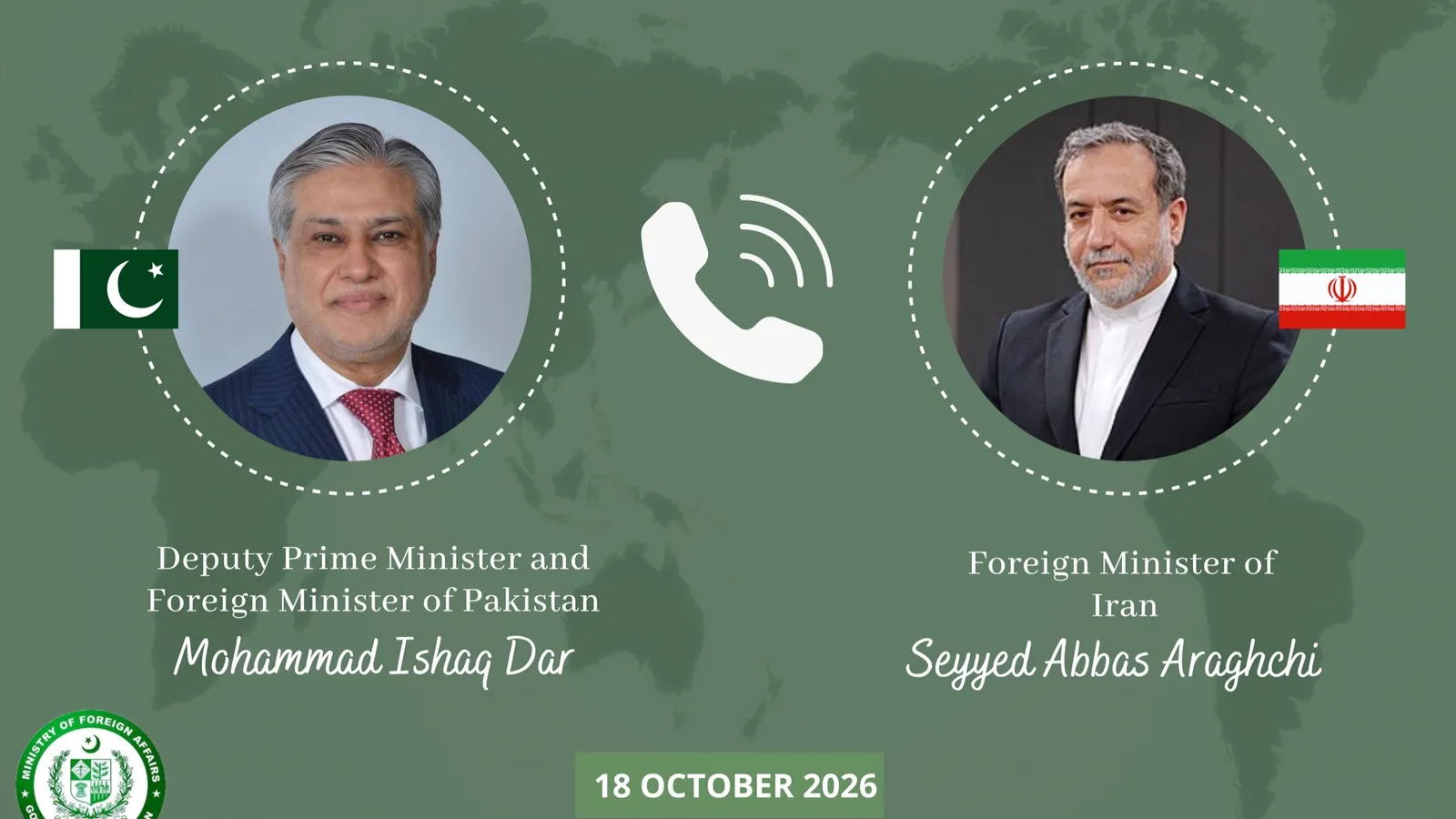
Deputy Prime Minister and Foreign Minister Ishaq Dar on Sunday stressed the need for continued dialogue and diplomacy in a telephone call with Iranian Foreign Minister Abbas Araghchi, as regional tensions persisted amid the US-Iran conflict and renewed fighting in Yemen, Dawn reported.
The Foreign Office said the two ministers discussed the evolving regional situation and the ongoing meeting of the Organisation of Islamic Cooperation’s Council of Foreign Ministers in Baghdad. Dar “underscored the importance of continued dialogue and diplomacy in addressing regional challenges”, the ministry said, and the two sides agreed to stay in close contact.
Dar’s call with Egypt
Dar also spoke by telephone to Egyptian Foreign Minister Badr Abdelatty. The two ministers strongly condemned Houthi attacks on Saudi Arabia and reaffirmed their solidarity with the kingdom and their support for its sovereignty, territorial integrity and security. They also discussed cooperation under the Regional Four (R-4) framework, which brings together Pakistan, Egypt, Turkiye and Saudi Arabia, and said they looked forward to the next R-4 meeting to coordinate on regional issues.
Tehran’s position
At the OIC meeting in Baghdad, Araghchi said Iran “does not accept coercion, threats, or intimidation” by the United States and “will not relinquish its sovereign rights under pressure”. “But it remains ready for dialogue based on mutual respect and credible guarantees,” he added.
He told the media that Iran’s offer to reopen the Strait of Hormuz within seven days was still on the table. “Our situation is clear and based on the seven-day proposal presented to the US,” he said. “They shared comments which we are reviewing, but our proposal is still on the table.”
If Washington showed “honesty”, he said, the way to reopening the strait was clear. Iran’s conditions include:
- lifting the US blockade on its ports;
- removing sanctions on its oil exports; and
- ending hostilities across regional fronts.
If the US accepted these terms, Araghchi said, the strait could reopen within six days, with talks resuming the following day.
Iran’s newly appointed defence minister, Mehrdad Akhlaghi, warned that any renewed US military attack would cause “enormous damage” to Washington and its regional allies. “People can rest assured that they will most likely not dare to attack us,” he told reporters after winning a parliamentary vote of confidence. “If they do, they themselves and the region will suffer enormous damage.”
President Masoud Pezeshkian, addressing parliament by video link before the vote, said he hoped the US-sanctioned nominee could “survive”, claiming that Akhlaghi was also on a US “assassination list”. The claim is Pezeshkian’s, and no evidence was offered, according to the report carried by The Express Tribune.
Vance admits “failures”
On the American side, US Vice President JD Vance acknowledged “a lot of mistakes and a lot of fundamental failures” in the handling of the Iran war, at a CBS News town hall on Sunday. He was responding to Joey Amor, whose wife, Master Sgt Nicole Amor, was one of six US Army Reserve soldiers killed in an Iranian strike on a military site in Kuwait in the first hours of the war, which began in late February. At least 21 US service members have been killed and hundreds wounded so far.
“Sometimes information doesn’t filter up to me,” Vance said, pledging to “take every single failure extremely seriously”. He admitted that the positioning of troops exposed weaknesses and said it had been changed. Asked why Washington had not secured a decisive victory, he said the US had “in some ways won decisively” but that “the enemy gets a vote here”. He added that the administration wanted a “final firm commitment from the Iranians that they’re not going to rebuild their nuclear program”.
Why it matters
Pakistan has consistently urged talks over force in the Gulf and keeps close contact with both Tehran and Riyadh. The two calls on Sunday show that balancing: dialogue with Iran, and solidarity with Saudi Arabia against Houthi attacks. Iran’s seven-day Hormuz proposal is the central open question for oil markets and for countries like Pakistan that depend on Gulf shipping. Read our report on Pakistan telling the UN Security Council it stands with Saudi Arabia.
This article draws on reporting by Dawn and The Express Tribune.
Comments
Comments are reviewed by our editors before they appear. Please keep them civil and on topic. See our terms.
No comments yet. Be the first to share your view.