

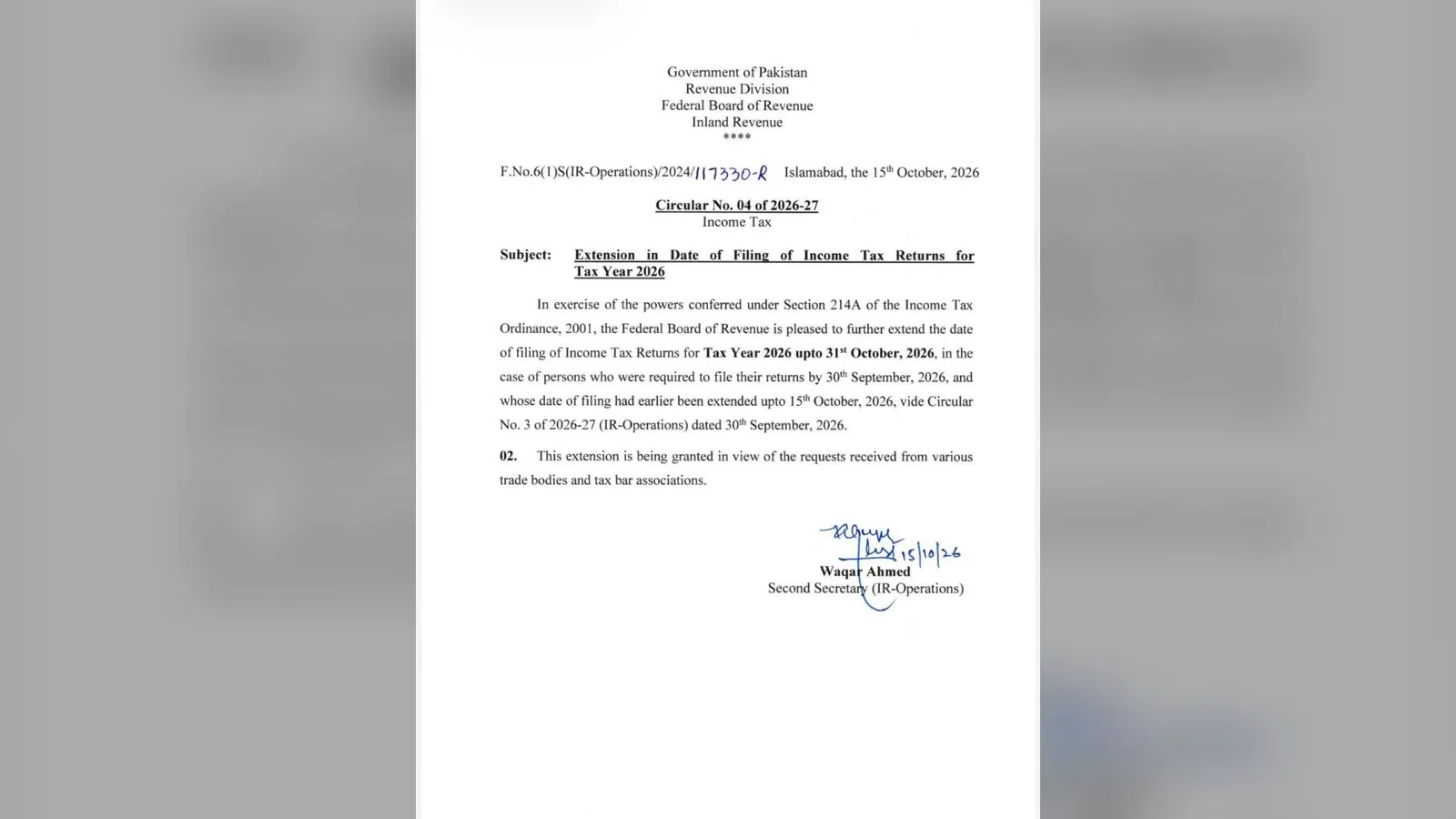
The Federal Board of Revenue (FBR) has again extended the deadline for filing income tax returns for tax year 2026, this time to October 31.
The notification, posted on the FBR’s X account, said the extension applies to people who were required to file by September 30 and whose deadline had earlier been pushed to October 15, Dawn reported. It was granted “in view of requests received from various trade bodies and tax bar associations”.
Why filers asked for more time
Trade bodies and tax professionals had cited delays in issuing return forms and heavy online traffic as major hurdles. Federation of Pakistan Chambers of Commerce and Industry President Atif Ikram Sheikh had formally asked for an extension to October 31.
The Karachi Tax Bar Association wrote a five-page letter to the FBR’s Member Inland Revenue (Operations), pointing to delays in draft notifications and persistent technical glitches in the IRIS portal.
Filings up sharply
According to official data seen by Dawn:
- Returns by October 14: 6.71 million, up 34.38 percent from 4.99 million a year earlier
- Returns by September 30: 5.76 million, up about 45 percent from 3.98 million
- Tax paid with returns: Rs66.81 billion by October 14, up 14.61 percent from Rs58.29 billion
- Non-salaried individuals: traders, shopkeepers, professionals and the self-employed filed 4.45 million returns, up 46.35 percent from 3.04 million
- Salaried individuals: 2.18 million returns, up 16.16 percent from 1.88 million
Traders’ scheme struggles
The FBR’s special scheme for small traders and shopkeepers has drawn only 130 returns, far below the 500,000 to 600,000 it expected, Sayyeda Maimuna of the FBR’s Transformation Delivery Unit told The Express Tribune.
Under the scheme, traders can pay a minimum annual tax of Rs25,000 or 1 percent of turnover and file a simple one-page return through the Tax Asaan app or online. Participants get protection from routine inspections, raids and shop sealing, with a green display outside their premises, and relief from some point-of-sale and digital invoicing requirements.
“We have brought this scheme to fill the gap. We want our tax base to expand,” she said, expressing disappointment at the low response despite consultations with trade bodies.
She said people earning below the Rs600,000 annual threshold do not have to pay income tax, though they may still need to file returns. Penalties for non-compliance can include fines, blocked SIM cards, disconnected electricity and sealed businesses, she said, and urged taxpayers to rely only on the FBR’s official website for deadline notices.
Maimuna said broadening the tax base would spread the burden more fairly across traders, professionals, property owners and salaried people, though she added that the benefits of wider compliance would come gradually.
Why it matters
More people are filing returns than ever, which helps spread the tax burden more fairly. But the traders’ scheme shows how hard it remains to bring shopkeepers into the system, even with simpler forms and protection from raids. Read our report on the World Bank’s review of Pakistan’s tax reforms.
This article draws on reporting by Dawn and The Express Tribune.
Comments
Comments are reviewed by our editors before they appear. Please keep them civil and on topic. See our terms.
No comments yet. Be the first to share your view.