

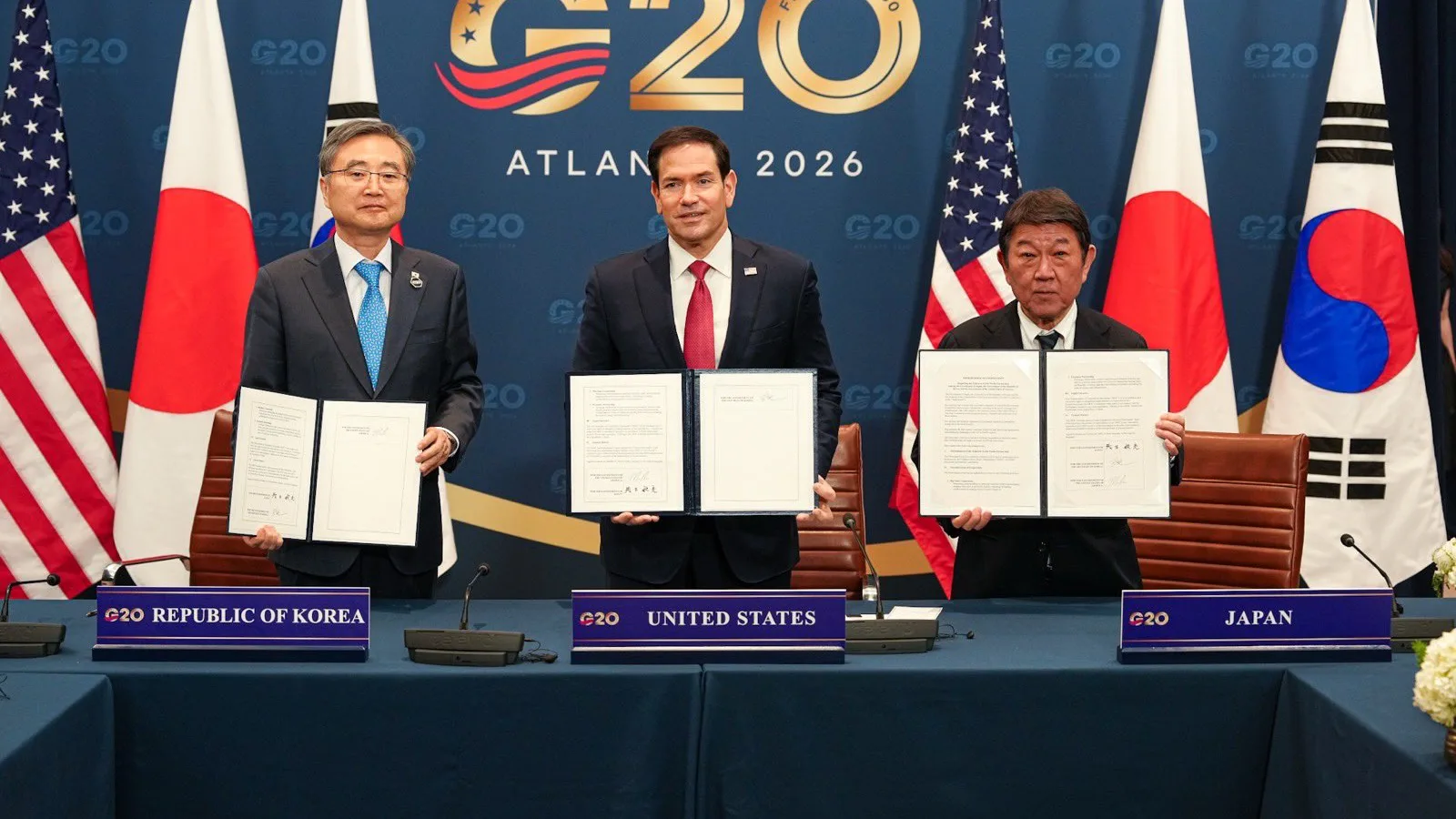
The United States, South Korea and Japan have reaffirmed their commitment to the “complete denuclearisation” of North Korea, even as Pyongyang keeps rejecting disarmament ahead of possible talks with Washington, Dawn reported, citing AFP.
US Secretary of State Marco Rubio, South Korean Foreign Minister Cho Hyun and Japanese Foreign Minister Toshimitsu Motegi “reaffirmed their resolute commitment to the complete denuclearisation” of North Korea during talks on Friday on the sidelines of the G20 foreign ministers’ meeting in Atlanta, Georgia, according to the US State Department. They also pledged “full implementation” of UN Security Council resolutions, including a ban on supporting revenue for North Korea’s nuclear and ballistic missile programmes.
Talks in the air
The statement comes amid growing speculation about a meeting between US President Donald Trump and North Korean leader Kim Jong Un at next month’s APEC summit in China. Trump has made repeated overtures to Pyongyang for nuclear talks while scaling back joint military drills with South Korea. Last year he broke with long-held US policy by saying North Korea was already “sort of a nuclear power” and that he was “100 per cent” open to a meeting; the suggestion went unanswered.
Analysts and South Korea’s spy agency say Kim may have passed Pyongyang’s position on talks to Beijing during a recent visit to the Chinese border city of Dandong.
What Pyongyang says
North Korea, which is backed by Russia and China, has enshrined its status as a nuclear-armed state in law, and its leaders repeatedly say the arsenal is permanent and irreversible. On Saturday, Pyongyang denounced a joint statement by a group of nations that monitor the implementation of sanctions against it. “The stereotyped sanctions racket of the US and the West can neither influence the position of the DPRK (North Korea) as a nuclear weapons state,” it said.
Differences over the goal
The three countries’ wording hides a debate. South Korea’s President Lee Jae Myung, who has repeatedly offered the North talks without preconditions, suggested in September that Washington seek a freeze, not immediate elimination, of the North’s nuclear programme in return for sanctions relief. Critics say this would tacitly accept North Korea as a nuclear-armed state and let it win relief without giving up its weapons. Analysts say China may also be moving towards tacit acceptance, pointing to the omission of denuclearisation from statements after Kim met Chinese President Xi Jinping in June.
What is not yet known
The reports we drew on do not say whether a Trump-Kim meeting at the APEC summit has been agreed, or whether Pyongyang has replied to any of the American overtures. Washington’s public line is still full denuclearisation, but Trump’s own earlier remarks, and the freeze idea from Seoul, show that the goal may be debated inside the alliance. Nothing in the State Department statement sets a date or a venue for talks.
Why it matters
The Atlanta statement is, above all, a message to Trump and to Pyongyang that his two allies in the region want any deal to keep the goal of full denuclearisation, whatever he says about meeting Kim. The G20 meeting where the statement was made was divided over Iran and Ukraine; see our report on Rubio hosting the G20 foreign ministers. Three things to watch are whether the APEC meeting with Kim takes place, whether Washington adopts Seoul’s idea of a freeze, and how Beijing positions itself.
This article draws on reporting by Dawn and AFP.

Comments
Comments are reviewed by our editors before they appear. Please keep them civil and on topic. See our terms.
No comments yet. Be the first to share your view.